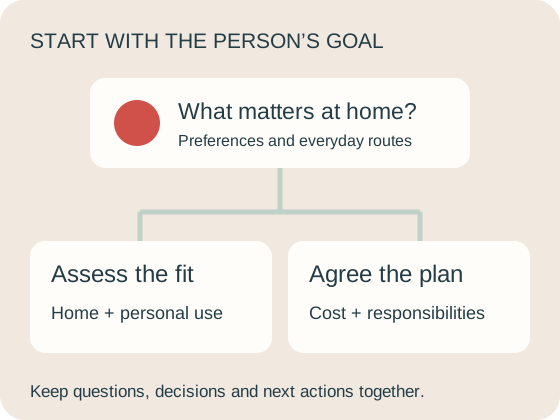
Start with the person’s goals, not a product shortlist
Ask what the person would like to reach and what is difficult about the current arrangement. “I want to use my upstairs bedroom” is a clearer starting point than “we need a curved model.” It gives the assessment a purpose while leaving room to consider different ways to achieve it.
The Administration for Community Living describes person-centered planning as directed by the person receiving support, with the people they want involved. [1] Apply that principle to this household decision: ask who should join the conversation, how information should be presented and what concerns have not yet been heard.
- Which rooms, activities or routines are most important?
- What would the person like to keep doing independently?
- What help do they want, and what feels intrusive or impractical?
- Which questions would they prefer to discuss privately with a professional?
- Who should receive proposals and help keep track of decisions?
Do not turn a family majority into a statement about the person’s wishes or legal authority. If someone acts as a representative, clarify the relevant role separately. A relative researching prices does not automatically become the person who can approve equipment, care or a contract.
Describe the whole journey through the home
Write down the route from the starting room to the destination. Include getting to the stairs, any intermediate landing, leaving the chair and continuing to the room. A photograph of the main flight alone can leave out the part of the journey that matters most.
NIA’s aging-in-place guidance recommends planning for current and future support and revisiting arrangements as needs change. [2] For a stairlift inquiry, describe what the household needs now and bring uncertainties about changing needs to the appropriate assessor rather than trying to predict them yourselves.
Use ordinary language for the home: split entry, bedroom upstairs, bathroom on another level, a door beside the bottom step, or a narrow hallway. Note which family members also use the route. The installer can translate those observations into a survey; the household does not need to decide the technical solution first.
Hypothetical example: a family initially describes one staircase, then records that reaching the bedroom also involves a second short flight and a landing door. It asks for a proposal covering the whole journey. This is an illustrative planning situation, not a customer project we inspected.
Our split-level guide shows questions for several flights. The equipment alternatives guide helps explain why the access task should be clear before narrowing the product category.
Give the installer and clinician the right questions
AOTA describes occupational therapy home-modification recommendations as based on the person’s needs, functional abilities, interests and goals, with follow-up potentially addressing fit and training. [3] That contribution is different from deciding which rail and installation arrangement a manufacturer supports.
| Question | Bring it to |
|---|---|
| Which activities and rooms matter? | The person using the equipment, with chosen support. |
| What equipment and route can be installed here? | The installer assessing the actual staircase and model. |
| Are seating, transfers or using the controls uncertain? | An appropriate healthcare professional, such as an occupational therapist. |
| What does a benefit cover and what approval is needed? | The responsible plan or program. |
| Who pays, signs and keeps the records? | The household and any appropriately authorized representative. |
Describe tasks and concerns without trying out an unsafe transfer to demonstrate a problem. A diagnosis alone does not tell this website which product is suitable. Tell the care team about the intended route and ask what it needs to assess; tell the installer which questions remain unresolved.
Where the recommendations depend on one another, ask how the professionals will coordinate, with the person’s permission. Keep technical and personal-use conditions visible on the proposal instead of assuming that one appointment resolves both.
Prepare useful photos and a short survey brief
Before taking pictures, ask the installer what it needs and use its intended submission method. A sensible brief identifies the beginning and end of the route, all flights and landings, nearby doors, and the spaces proposed for boarding and parking. These are conversation aids, not measurements that certify a fit.
- Take photos only from places you can stand safely. Do not lean over a stairwell or climb onto furniture.
- Keep people, financial papers, medicine labels and unrelated personal possessions out of the images where possible.
- Describe a feature you cannot photograph safely; leave measurement and inaccessible inspection to the survey.
- Label each image by location, such as “lower landing looking toward the door.”
- List questions alongside images rather than drawing an unapproved rail route.
Have the person who will use the lift join the assessment where appropriate. Ask ahead about communication needs and who may attend. Avoid booking an assessment around a family member’s schedule without considering the actual user’s participation.
Afterward, request a written summary of the proposed model, route, options and outstanding decisions. See the installation guide for survey and handover questions and the hinged-rail guide for doors near the stairs.
Compare the same job and agree who handles payment
Choose one person to collect proposals, but keep the decision visible to everyone who needs to participate. Ask each business to quote the same required route and features. Keep optional extras separate so a change in scope does not look like a simple price difference.
Use the quote comparison tool to record charges and unknowns. Have the supplier explain what is excluded, who provides aftercare and what the household must arrange before installation. A lower headline price is not a complete answer if a required task remains unpriced.
Discuss spending without asking anyone to disclose private financial details in a shared website worksheet. Agree who needs to see the amount, who can authorize a deposit and what must be resolved first. Ask the relevant program about approval before relying on assistance; use our funding guide to organize that inquiry.
If financing is being considered, compare the full obligation and written terms separately from equipment suitability. The financing guide and payment-plan illustration help frame those questions. They do not determine what the family can afford or whether credit will be approved.
Keep unresolved points on the decision record. “Ask the installer who handles electrical preparation” is more useful than silently assuming someone has included it.
Plan handover, downtime and the next review
Before installation, ask who should attend the demonstration and how instructions will be provided. Request the correct owner manual, agreed checks, warranty documents and a named service contact. Give the person using the lift time to ask questions; do not treat the installer’s departure as evidence that every household concern has been resolved.
Record what still needs follow-up and who will arrange it. If the person needs further help learning or using the equipment, ask the appropriate professional about that support. Do not improvise transfer techniques or assume family assistance makes an unassessed arrangement suitable.
Discuss what the household will do if the lift is unavailable. Identify a contact, essential access needs and an appropriate alternative plan with the care team where needed. A service telephone number alone does not provide access to another floor while waiting. Do not promise that a relative can physically carry someone or arrange an unsafe workaround.
Keep completed work in the service record. Return to the family plan when the person’s goals, home layout, available support or equipment use changes. This article organizes the conversation; it does not certify a home, prevent falls or replace an individual assessment.
Common questions
Should I order a stairlift as a surprise for a parent?
Start by involving the person in the goals, assessment and options. Equipment and installation affect their home and daily routine. A gift or payment offer does not replace their participation or the professional assessment of the proposed use.
Does the person using the stairlift need to attend the survey?
Ask the supplier and relevant clinician how the person should participate and what assessment is needed. A survey completed around an absent user may leave important seating, controls or boarding questions unanswered. Clarify those limits before treating the proposal as complete.
Is an installer’s survey the same as an occupational therapy assessment?
They address different questions. Discuss the technical installation with the installer and personal-use uncertainties with an appropriate healthcare professional. Ask how findings will be coordinated when the equipment choice depends on both.
Can we choose a model based on a parent’s diagnosis?
This guide cannot match a diagnosis to a product. Explain the person’s goals and practical concerns to the relevant assessor, and have the installer evaluate the home. Keep uncertain seating, transfers or control use open for individual assessment.
What if family members disagree about the purchase?
Separate the disagreement into the person’s preferences, unanswered assessment questions, cost and responsibilities. Record the missing information and who can answer it. If authority to decide or sign is disputed, seek appropriate advice rather than treating a family vote as authorization.
Does the worksheet request a quote or contact an installer?
No. It is a blank planning document for the household to complete and retain. It does not submit information, book a survey or establish an installer relationship. The website’s private-preview enquiry process is separate.
Evidence & accountability
Sources and research method
We reviewed the linked manufacturer, provider and public guidance. Published terms are attributed to that source and can change. These guides use original explanations and clearly marked hypothetical examples; we have not inspected the equipment or performed these installations.
Prepared with AI assistance. No independent installer or clinical review is claimed. A qualified installer must assess the home and proposed equipment. Read our research method and evidence standards.
- ACL: Person-Centered Planning ↗Checked October 25, 2026
Primary-site indexed text supports the general planning principle; direct retrieval returned 403. Not a stairlift suitability protocol or legal authority determination.
- NIA: Aging in Place—Growing Older at Home ↗Checked October 25, 2026
Primary-site search retrieval supports planning and revisiting needs. Direct page retrieval required a JavaScript verification step.
- AOTA: Home modifications and occupational therapy ↗Checked October 25, 2026
Professional association description of OT’s role; no individual assessment or endorsement obtained.
- NIA: Caregiver Worksheets ↗Checked October 25, 2026
Primary-site search retrieval; reviewed April 11, 2023. Our stairlift worksheet is original, not an NIA form.
Keep planning
Melt Media Group reviews your request and follows up about installer options. We identify the proposed company and ask before sharing your details.