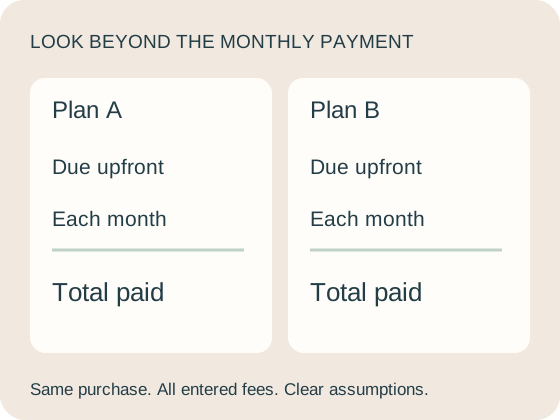
Get the complete cash price before comparing payments
Ask the installer for one written price covering the specified lift, rail, options, installation and any included service. Identify taxes and excluded work. Then ask for the payment proposal for that same scope. Otherwise, a comparison can accidentally put a basic installation beside a more expensive package.
Keep the purchase and the credit agreement side by side. Record the business supplying the lift, the creditor, and the business that will collect payments. Ask when money is released to the installer, when the first payment is due, and what happens if installation is delayed or the purchase changes.
Use a simple worksheet with three headings: due before installation, scheduled later, and not yet priced. A deposit toward the purchase and a lender's fee belong on different lines. Ask whether any cash discount is lost by using a payment plan; compare the actual offers you receive rather than assuming their purchase prices are identical.
The quote checklist helps establish the installation scope. This guide explains financing documents and arithmetic; Hello Upstairs does not provide credit, determine eligibility or recommend a lender.
Keep interest rate, APR and total payments separate
The CFPB distinguishes the contract interest rate from APR, which also reflects applicable borrowing fees. [1]
For covered closed-end consumer credit, Regulation Z identifies disclosures including the creditor, amount financed, finance charge, APR, payment schedule and total of payments. [2] Ask the lender to explain its actual document and the credit product it is offering. A revolving credit card and an installment loan need different comparisons.
| Figure | What to record | Question to resolve |
|---|---|---|
| Cash price | The complete agreed installation price. | Is the financed purchase priced differently? |
| Down payment | The amount paid toward the purchase before borrowing. | Has an earlier deposit already been counted? |
| Contract interest rate | The annual rate and whether it is fixed. | How does the agreement calculate interest? |
| Disclosed APR | The lender's stated APR. | Which charges are reflected in it? |
| Schedule and total | Every scheduled payment, including any different final payment. | What is due outside those payments? |
Keep the lender's formal labels intact. Regulation Z's amount-financed calculation addresses prepaid finance charges, so that disclosure can differ from a calculator's starting loan balance. [2] Our tool calls its arithmetic result modeled principal; it does not reproduce a legal disclosure.
Find fees and optional items before choosing a term
The CFPB's personal-installment-loan guidance identifies origination, documentation and late fees among possible charges; it also notes that credit and disability insurance are generally optional. [3] Ask which items apply to the particular offer and request a version without optional additions so their effect is visible.
For each fee, record whether you pay it upfront, it is added to the balance, or it is withheld from the money advanced. Those arrangements should not be entered as if they were the same. If an offer withholds a fee, ask the lender to reconcile the amount available for the installation with the amount you must repay.
Ask for the complete schedule at any term you are considering. With the same principal and a positive fixed interest rate, stretching ordinary monthly amortization over more months lowers the payment but increases total modeled interest. That mathematical relationship does not identify which payment is affordable for your household.
Keep installation exclusions and future service costs outside the loan comparison until you know whether they are financed. A manageable payment for the lift does not resolve an unpriced electrical job or later maintenance. The cost guide covers those separate project questions.
Check whether “no interest” means deferred interest
The CFPB distinguishes a genuine zero-interest promotional period from deferred interest: deferred charges can reach back to the purchase date if the promotional balance is not fully repaid by the deadline. A true zero-interest period does not add that period's interest retroactively merely because a balance remains. [4]
The CFPB's current deferred-interest explanation also warns that certain late-payment conditions can trigger the deferred charges. [5] Read the agreement rather than treating a headline such as “no interest” as the complete offer.
- What is the exact promotional end date?
- What payment is required to clear the promotional purchase by that date?
- Is that different from the minimum payment shown on the statement?
- What rate applies after the promotion, and can earlier interest become payable?
- How are payments allocated if the account has other balances?
- What happens after a late payment, returned payment or refund?
Ask the issuer to answer against the written offer and the account you would use. Our fixed-rate tool does not calculate card payment allocation, deferred charges or a later promotional rate change. Entering zero in that tool cannot verify that a promotional offer costs nothing.
One example: follow the money from price to final payment
Hypothetical illustration, not a quote: suppose the complete cash price is $8,000. You pay $1,000 down and a separate $150 upfront fee. A further $200 fee is financed. The contract interest rate is 8% annually, fixed for 36 months. No other charges are assumed.
| Calculation | Illustrated amount |
|---|---|
| Modeled principal | $8,000 − $1,000 + $200 = $7,200. |
| Monthly rate used | 8% ÷ 12. |
| Regular monthly payment | Approximately $225.62, with a final rounding adjustment. |
| Total loan payments | Approximately $8,122. |
| Modeled interest | Approximately $922. |
| Total cash outlay | $1,000 down + $150 upfront fee + approximately $8,122 in payments = approximately $9,272. |
| Extra over the cash price | Approximately $1,272, comprising the two fees and modeled interest. |
Totals above are rounded to whole dollars for readability. The example assumes monthly interest on the remaining balance and end-of-month payments, with no missed or early payments. It also assumes the financed fee earns interest. A lender's accrual and rounding conventions can produce a different schedule.
The 8% input is the assumed contract rate, not a calculated APR. The fees are counted once: the upfront fee separately and the financed fee within principal. Adding the financed fee again to the total would overstate the expense.
Use the comparison tool for the offers it can model
Our stairlift financing comparison illustrates fixed-rate monthly installment payments from the cash price, down payment, upfront fee, financed fee, contractual annual interest rate and term. Enter fees separately and use the contract rate in the rate field.
It assumes the annual rate divided by twelve, regular payments at each month's end and a final adjustment for rounding. It does not model variable rates, promotional cards, deferred interest, balloon payments, missed payments or early payoff. It does not calculate APR or determine whether credit is suitable for you.
Use the print or CSV export to keep the assumptions with the result. Compare the illustration with the lender's schedule and ask about differences. If the agreement uses daily interest, unusual first-payment timing or another structure, the lender's explanation is necessary; changing inputs until an approximate figure matches is not verification.
The tool runs in your browser and is not a credit application. Do not enter account numbers, Social Security numbers or other identifiers. Its purpose is to make a stated set of payment assumptions easier to inspect.
Ask about early repayment and a changed installation
Regulation Z's applicable closed-end disclosures address prepayment penalties or finance-charge rebates, depending on the loan structure. [2] Request the actual terms; silence on a sales page does not settle them.
Ask how to obtain a payoff amount for a particular date, whether extra payments reduce principal, and whether any upfront charge is refundable. If you plan to repay sooner, request a lender-produced illustration rather than assuming the original payment total is what you would owe.
Also discuss what happens if the installation is canceled, delayed or changed after credit approval. Who receives a supplier refund? How is it credited to the account? What written confirmation closes the balance? Keep the installation agreement and credit documents together, and ask each party to explain its responsibilities.
Do not treat a dispute with an installer as automatic permission to stop paying a lender. Ask the creditor about its applicable dispute process and obtain appropriate advice for the agreement involved.
Resolve these questions before applying or signing
The FTC warns about advance-fee schemes that promise guaranteed credit in exchange for payment. It distinguishes those promises from legitimate application or appraisal fees, which do not guarantee approval. [6]
Confirm the creditor's identity through its own official contact details and obtain the full offer in a form you can retain. Ask whether an initial eligibility check affects your credit report, what information is required, when an application becomes binding, and how long the quoted terms remain available.
Before signing, make sure you can answer: What is being installed? What is due now? What is every later payment? Which costs are still unknown? What happens if the plan changes? These questions organize the decision; they do not replace an assessment of your wider finances.
Editorial status: this research guide has not yet received independent financial-professional review. It presents public-source explanations and an illustrative calculation, not a personalized borrowing recommendation.
Common questions
Should I compare monthly payments or the total cost?
Record both, along with what is due upfront and the exact installation scope. Monthly payments help describe the schedule; the total and exclusions show what that schedule would cost under its assumptions. Neither figure alone establishes affordability.
Is the interest rate the same as APR?
No; keep the two labeled figures separate. [1] Our illustration tool asks for the contract rate. Copy it from the offer or ask the lender to identify it.
Does zero interest mean there are no fees?
Check the fee schedule and the purchase price separately. Ask the lender to identify every upfront, financed and possible later charge. Also establish whether the offer is a true zero-interest promotion or a conditional deferred-interest arrangement.
Can I use the tool for a deferred-interest card?
No. It assumes ordinary fixed-rate monthly installments and does not calculate promotional deadlines, card payment allocation or retroactive charges. Ask the card issuer for the applicable payment plan and the consequences of missing its conditions.
Can I pay off the financing early?
Request the agreement’s early-payment terms and a payoff quote for the intended date. Ask about penalties, any finance-charge rebate and how additional payments are applied. The original scheduled total is not an early-payoff quote.
Does Hello Upstairs approve or arrange financing?
No. Our guide and browser tool provide a way to inspect stated costs and assumptions. They do not submit an application, verify credit eligibility, guarantee approval or identify a best lender for your circumstances.
Evidence & accountability
Sources and research method
We reviewed the linked manufacturer, provider and public guidance. Published terms are attributed to that source and can change. These guides use original explanations and clearly marked hypothetical examples; we have not inspected the equipment or performed these installations.
Prepared with AI assistance. No independent installer or clinical review is claimed. No independent benefits, financial or tax review has been completed. A qualified installer must assess the home and proposed equipment. Read our research method and evidence standards.
- CFPB: loan interest rate and APR ↗Checked October 25, 2026
Auto-loan explainer; only its general distinction is used.
- CFPB: Regulation Z, section 1026.18 ↗Checked October 25, 2026
Applicable closed-end disclosures; credit-card and mortgage rules differ.
- CFPB: personal installment loan fees ↗Checked October 25, 2026
Reviewed August 30, 2024; no particular lender offer evaluated.
- CFPB: promotional financing offers on credit cards ↗Checked October 25, 2026
Archived June 2017 explainer; used for the promotion distinction.
- CFPB: no interest if paid in full ↗Checked October 25, 2026
Reviewed January 22, 2024; confirm the actual card agreement.
- FTC: what to know about advance-fee loans ↗Checked October 25, 2026
Consumer guidance; no specific lender was evaluated.
Keep planning
Melt Media Group reviews your request and follows up about installer options. We identify the proposed company and ask before sharing your details.