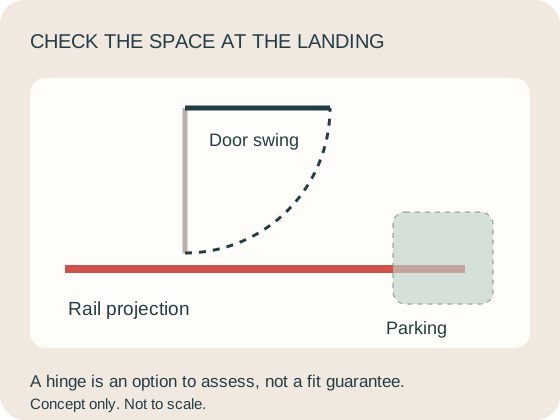
Identify the obstruction before choosing a rail option
A lower rail extension can create a conflict near a doorway or passage. Stannah's US rail guide describes powered folding or retractable options for an obstructed bottom of a straight staircase. [1] Treat that as a starting point for the survey, not confirmation that any particular door can remain usable.
Describe the actual problem: a door hits the proposed rail, the rail crosses a walking route, or the parked chair occupies space the household needs. Those are different conflicts. Ask the supplier to identify which one its proposed option resolves and which questions remain.

Supplier terminology varies. Ask for the actual product name and explanation of what moves; do not assume “hinged,” “folding” and “retractable” describe identical mechanisms. Keep a chair's folding seat or swiveling action separate from a moving section of rail.
A photograph can show the conflict but cannot establish the remedy. Share the location of the door, the normal walking route and the intended boarding point. Leave the rail position and option selection open until the installer has assessed the complete arrangement.
Check what the manufacturer documents for the model
These are selected published examples checked October 25, 2026, not a compatibility catalog. Ask the supplier to identify the exact US model, variant and option in the order. A feature appearing in a manual does not mean every unit has it fitted.
| Published model or scope | Documented rail option | What still needs confirmation |
|---|---|---|
| Bruno straight indoor range | Manual or powered folding lower rail. [2] | Quoted model, compatibility and included configuration. |
| Acorn 130 manual | Manual and automatic hinge installations described. [3] | Applicable unit and supplied manual revision. |
| Acorn 180 Curved US page | Automatic powered hinge option. [4] | Assessed doorway and route arrangement. |
| Stannah Siena 600 US manual | Optional automatically raising retractable rail. [5] | Installed option and required parking routine. |
The Acorn 130 hinge details were available in the indexed text of the official manual; direct retrieval of its large PDF was unavailable during this review. The table uses that narrow evidence only. Request the current document supplied for the proposed installation.
No row establishes that an option can be added later to an existing lift. If a seller proposes a retrofit, request a model-specific compatibility decision and written scope from the responsible installer. Do not buy a component solely because it resembles a rail pictured here.
Compare the actions required during a normal day
Compare the user's routine before comparing the option price. Ask the supplier to demonstrate who initiates the rail movement, where that person stands or sits, and what happens after the rider leaves the chair. A powered mechanism may still require a person to complete a parking or calling action.
For a manual proposal, ask the assessor to explain every physical action and the position from which it is performed. Do not assume the intended rider can complete it or that another household member will always be available. If movement, reach or balance is uncertain, have the person's needs assessed by an appropriate healthcare professional alongside the equipment survey.
For a powered proposal, ask the same questions about controls and sequence. Which action starts the movement? What indicates completion? What must remain clear? How is the chair obtained for the next journey? Have the answers explained for the actual option rather than through a demonstration of a different model.
Include the return journey in the discussion. A solution that appears convenient while a family member is present may depend on that assistance later. Record the agreed responsibilities so the choice reflects ordinary use of the home.
These are questions for assessment and handover, not operating instructions. Follow the manual and training supplied for the installed lift; this guide does not describe lifting, releasing or overriding a rail mechanism.
Check the door, rail and chair separately
Stannah's US installation guide distinguishes a bottom doorway's rail/chair clearance from a top doorway's travel and seat-swivel clearance. [6] A lower hinge option should not be treated as a solution to an unrelated top-landing conflict.
Ask the surveyor to show three things on the proposed arrangement: the space used by the door as it moves, the area occupied by the rail in its different positions, and where the chair parks. Mark the place where the rider gets on or off separately. This makes it easier to see which claim the quotation is actually making.
Then describe how people use that area. Is it the normal entrance from a garage? Does someone carry shopping through it? Is the doorway used while the lift is parked? These are practical household facts to give the assessor, not reasons to make your own clearance calculation.
Ask the supplier to explain the full proposed arrangement before agreeing to preparation work. A rail option does not itself authorize changing a door, removing a handrail or narrowing an exit. Any required work and applicable approval questions should have a named responsible party.
For a landing linking several flights, keep this discussion attached to the complete route. The split-level planning guide helps separate a doorway problem from a transfer or middle-floor access problem. No conceptual diagram here is evidence that an installation meets local requirements.
Resolve where the chair goes after a bottom arrival
The Stannah Siena 600 manual links its optional retractable rail to a specific parking routine: after a bottom arrival, the chair must return upward to clear the passage and charge. It also requires a clear area around the rail before movement. [5] Do not transfer those instructions to a different product.
The Acorn 130 manual's hinge section describes an intermediate charge position above the folding section for manual and automatic configurations. [3] This is another reason to ask for the actual manual rather than assume the bottom stopping point is the normal place to leave every chair.
Have the installer identify the normal arrival point, approved boarding position and resting/charging position for your unit. Ask whether they coincide and who completes any action between them. Keep that explanation with the handover paperwork and make sure the intended user understands the relevant controls.
A useful demonstration covers the complete cycle: the person arrives, gets off according to the supplied instructions, and the equipment is left in its intended state. Ask how the next journey begins from each landing and what normal indicators confirm the arrangement is ready. Do not experiment with alternate parking points to see whether they work.
If charging information is unclear, resolve it with the supplier before relying on the lift. The battery guide explains why charging instructions belong to the exact installed configuration.
Get the complete rail arrangement in the quote
Ask for the model and rail option to be named on the proposal, with the assessed route and parking positions attached. “Powered options included” is too vague to show whether it refers to the rail, seat swivel, footrest or more than one feature.
Request an installed total for the proposed arrangement and identify any unpriced preparation. This guide has no independently collected hinge-price dataset. It cannot establish a national surcharge, a guaranteed saving over another layout or the cost of a retrofit that has not been assessed.
| Item to resolve | Written answer to request |
|---|---|
| Model and compatibility | Exact lift, rail option and approved configuration. |
| Installation and preparation | Included work, exclusions and the party arranging any separate work or approvals. |
| Daily operation | Manual supplied, demonstration and required parking/charging arrangement. |
| Aftercare | Service contact and which parts, labor and visits the written coverage includes. |
If the option changes during the survey or installation planning, ask for the proposal to be revised before treating the earlier total as final. Use the quote comparison tool and warranty comparison to keep missing terms visible.
Leave handover with a clear service plan
Before the installer leaves, ask which manual section covers the fitted rail and how to contact the service business. Have the intended user explain the normal routine back to the installer so any uncertainty can be resolved during training. Keep the model identification and service details somewhere accessible.
Stannah's US technical-assistance page routes a hinge or retractable-rail fault to Stannah or the local distributor. [7] For another brand, use the service route named in its supplied documentation or installation agreement. This article does not establish a response time or available appointment.
If the rail is damaged, behaves unexpectedly or creates an obstruction, stop using the equipment and contact the responsible service provider. Keep people away from the affected area while arranging help. Do not force the mechanism, bypass a safety device or improvise a prop to keep it out of the way. Seek emergency help if someone is in immediate danger.
From a safe position, note the model, displayed message and when the issue appeared. Tell the service business whether a doorway or passage is affected so it can understand the situation. Avoid approaching or moving the rail merely to obtain a photograph.
The repair guide covers service preparation in more detail. The evidence here is manufacturer documentation, not hands-on product testing or an independent inspection of a home.
Common questions
Is a hinged rail the same as a folding seat?
No. Ask the supplier to distinguish the rail option from the chair's seat, footrest and swivel features. The written order should identify each selected feature so a general promise of folding or powered operation is not mistaken for the required rail configuration.
Can a curved stairlift have a powered hinge?
Acorn's US 180 Curved page lists that option. [4] That is a documented example, not a rule for all curved models. Confirm compatibility and the assessed arrangement on the actual proposal.
Will a hinged rail solve every doorway problem?
No such assurance follows from the option name. Ask the installer to assess door movement, the chair's parking and boarding positions, and the moving rail. A conflict at the top landing may be different from the lower-rail issue the option addresses.
Can a hinge be added to an existing stairlift?
Compatibility remains unknown until the responsible installer identifies and assesses the existing equipment. Provide its model and installation details. Request a written scope before buying a rail component; this guide does not establish retrofit compatibility.
How much does a powered hinged rail cost?
Request a current itemized installed quote for the exact option and any associated work. The sources used here do not provide a comparable national price dataset, so this guide does not publish an average or assume every supplier prices the feature separately.
Can I manually raise a powered rail if it stops working?
Do not infer a procedure from another model or this comparison. Stop use, keep clear of the affected mechanism and contact the supplier for instructions specific to the installed unit. Do not force it or bypass its safety devices.
Evidence & accountability
Sources and research method
We reviewed the linked manufacturer, provider and public guidance. Published terms are attributed to that source and can change. These guides use original explanations and clearly marked hypothetical examples; we have not inspected the equipment or performed these installations.
Prepared with AI assistance. No independent installer or clinical review is claimed. A qualified installer must assess the home and proposed equipment. Read our research method and evidence standards.
- Stannah US: rail types and lower-stair obstructions ↗Checked October 25, 2026
Published straight-stair option context; no universal mechanism or fit assumed.
- Bruno: manual and powered folding rail options ↗Checked October 25, 2026
Published scope is straight indoor stairlifts; exact quoted compatibility requires confirmation.
- Acorn: 130 user manual, hinge section, page 16 ↗Checked October 25, 2026
Indexed official PDF text retrieved; direct 28.7 MB PDF fetch exceeded the tool limit. Verify supplied revision.
- Acorn US: 180 Curved powered hinge option ↗Checked October 25, 2026
Option existence only; no assurance it resolves a particular doorway.
- Stannah US: Siena 600 manual, retractable rail, page 10 ↗Checked October 25, 2026
Model-specific optional rail and parking/charging requirements; no override procedure reproduced.
- Stannah US: doors at the top and bottom of stairs ↗Checked October 25, 2026
Different clearance questions identified; alteration and minimum-width claims not adopted.
- Stannah US: technical assistance for rail faults ↗Checked October 25, 2026
Manufacturer/distributor service route only; no attendance promise or repair procedure adopted.
Keep planning
Read local installation research
Chicago, IL · Dallas, TX · Los Angeles, CA · All cities
Prepare your stairlift enquiry ↗Melt Media Group reviews your request and follows up about installer options. We identify the proposed company and ask before sharing your details.