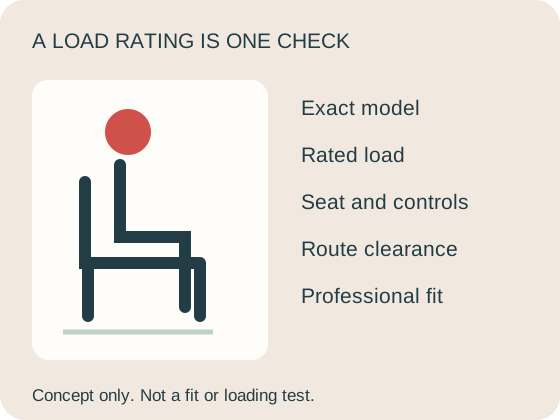
Use the rating for the actual equipment
Start with the complete model description, the intended installation and the manufacturer documentation supplied for that unit. Keep the capacity stated in the order aligned with the installed equipment. A seller's brand-wide statement, an old owner's manual or a similar-looking online listing is not enough.
The US Siena 600 manual specifies a 350-lb maximum and one rider. [6] This is an example of a defined model rule. Do not increase a stated limit because a motor appears powerful or because someone says the equipment is tested with a heavier load.
If weight is close to a listed maximum, give the installer accurate information privately and ask for written confirmation of the suitable configuration. Do not round down to fit a brochure number or calculate your own allowance above it. The required rating and any permitted items need confirmation for the proposed use.
For a secondhand lift, obtain identification and the correct documentation before relying on the rating in a new-product advertisement. The used-lift guide covers the additional condition, installation and support questions. If documents disagree, resolve that disagreement before purchase or use.
Published US examples by model and configuration
These figures were checked October 25, 2026. They are a starting point for inquiries, not confirmation that any model fits your stairs or that a particular order has the same specification. The table intentionally separates standard and higher-capacity configurations.
| Equipment | Configuration | Published limit | Qualification |
|---|---|---|---|
| Acorn 130 | Straight indoor product table | 280 lb [1] | General FAQ differs; confirm US order rating. [9] |
| Acorn 180 | Curved indoor product table | 265 lb [2] | General FAQ differs; confirm US order rating. [9] |
| Bruno Elan | Straight indoor | 300 lb [3] | Confirm the supplied model and options. |
| Bruno Elite Straight | Straight indoor | 400 lb [4] | Assess seat fit separately. |
| Bruno Elite Curved | Curved indoor | 400 lb [5] | Assess the custom route and boarding space. |
| Stannah Siena 600 | Straight; US manual | 350 lb [6] | Verify the installed version. |
| Stannah Siena 260 | Standard curved; US manual | 300 lb [7] | Do not assume the Plus rating applies. |
| Stannah Siena, 260 Plus option | Higher-capacity curved configuration | 352 lb [8] | The option must be explicitly confirmed. |
The brand comparison explains the associated equipment and service questions. These selected examples do not establish the industry's highest capacity, nor do they rank the products by safety or comfort.
Resolve conflicting numbers and similar model names
Acorn's FAQ differs from its model tables. [9] Obtain the confirmed rating for your US order; no variant reconciliation has been verified here.
Send the supplier both conflicting documents, with their URLs or dates. Ask it to identify the correct model, revision and configuration instead of simply repeating the larger number. Request the relevant technical sheet or supplied manual and have the agreed specification appear on the order.
Product names can also describe more than one arrangement. In the Stannah examples, standard Siena curved and Siena with the 260 Plus option are separate capacity entries. [8] A quotation that says only “Siena” leaves a necessary detail unresolved.
Do not convert an indoor rating into an outdoor rating or a straight configuration into a curved one without matching documentation. If a seller proposes a different model after the survey, reopen the rating question even when the seat looks familiar or the brand is unchanged.
Keep discrepancies marked as unresolved until the supplier answers them. Choosing the smaller number may feel cautious, but it still does not identify the supplied equipment. Choosing the larger number may overstate its rating. The useful outcome is a consistent, traceable specification for the actual installation.
Check seat dimensions separately from the load limit
A weight rating answers a different question from how the person sits. Ask for usable width between the arms, seat depth, seat height, the footrest arrangement and the space needed when turning at a landing. An overall chair-width dimension is not automatically the clear sitting width.
Bruno lists larger seat and footrest options for Elite Straight. [4] That is a reason to discuss the proposed configuration, not evidence that every larger seat changes the lift's rated capacity. Ask the supplier to state the rating and dimensions of the selected combination together.
Where a suitable demonstration can be arranged, verify that it matches the proposed seat and options. Ask what differs from the equipment that will be installed. A person may find a demonstration useful while the home still needs a separate assessment of travel and turning space.
| Question | Information needed |
|---|---|
| Is the load within the rating? | Confirmed specification for the actual configuration. |
| Does the seat fit? | Usable dimensions and assessment of the intended user. |
| Is there travel clearance? | Home survey of the occupied seat, legs and route. |
| Can boarding work? | Landing space, seat position and transfer assessment. |
Ask the installer to record any limitation instead of describing the result simply as “it fits.” The narrow-stairs guide explains why one staircase-width measurement does not resolve the full journey.
Assess boarding and everyday use, not only the journey
Write out the sequence the person needs to complete: approach the chair, get seated, use the required controls, travel, turn or exit at the landing, and continue to the destination. Note where help may be needed. This is a way to prepare for an assessment, not a transfer technique to try without support.
Ask the equipment supplier how the proposed chair and landing arrangement work. If sitting balance, standing, transfers or the ability to operate controls is uncertain, request an occupational-therapy or other appropriate healthcare assessment. A published weight figure does not answer those personal suitability questions.
- Where will any walking aid be available at each end?
- Is there room for any assessed assistance at the boarding positions?
- Who will fold or unfold the equipment when needed?
- Can the person use the proposed controls and belt as intended?
- If a turn requires changing lifts, has that transfer been separately assessed?
- What alternative access plan is needed if the lift is unavailable?
Do not select a perched, standing or different-seat arrangement solely to solve a space or weight problem. Have the intended use assessed against the product instructions and the person's needs. If the household needs to travel in a wheelchair rather than transfer to a chair, explain that requirement at the outset so the assessor can consider an appropriate equipment category.
Keep the result in plain language on the proposal. “Powered option required because of the assessed task” is more useful than a list of attractive features with no explanation of which ones the person actually needs.
Discuss the intended load and future changes accurately
Ask the supplier what is included in the rated load and which items, if any, may accompany the rider. Tell it about a necessary medical or personal item before assuming it can travel on the lift. Permission, secure placement and clearance are separate questions from its weight.
Do not turn an unused portion of the rating into permission to carry another person, transport an animal or use the chair as a goods lift. Follow the instructions for the actual unit. A numerical calculation cannot authorize a use that the equipment is not intended to support.
If weight or the way the person needs to use the lift changes, contact the responsible supplier before relying on the previous assessment. Ask whether the existing configuration remains appropriate and whether a new suitability review is needed. A change in personal needs and a mechanical fault may require different professionals.
A term such as heavy duty is not enough on an order. Request the actual rating, selected components and configuration. Do not assume a replacement battery, different upholstery or a larger-looking chair increases the approved limit; any proposed modification needs the manufacturer's applicable documentation and professional assessment.
If an existing lift behaves abnormally, stop treating that as a capacity experiment. Use the service route for the exact model. The battery guide separates charging questions from assumptions about the equipment's capability.
Put the confirmed rating and fit checks on the order
Ask the supplier to complete this short record before you commit. It joins the numerical specification to the actual equipment and the assessed use.
- Model: full manufacturer, chair/model identification and version.
- Configuration: straight or curved, indoor or outdoor, and any capacity option.
- Rating: the permitted load for the supplied arrangement and the document supporting it.
- Seat: selected dimensions, footrest and required powered options.
- Route: boarding points, turning positions and clearance findings.
- User needs: what was assessed and which questions need another professional.
- Handover: confirmation that the installed unit matches the accepted specification.
Keep that record with the order and the supplied manual. If there is a substitution, a missing option or an unexplained difference at installation, ask the installer to resolve it before using the lift. Take a record of the externally accessible identification where it can be done safely.
For later maintenance or a proposed move, use the same identification when contacting the provider. The maintenance guide and relocation guide explain why instructions and a new staircase assessment must follow the actual equipment.
This guide reports published examples and organizes the assessment questions. It does not certify an individual unit, inspect your home or determine a person's medical suitability for a stairlift.
Common questions
What is the weight limit for a stairlift?
It depends on the exact model and configuration. Use the cited examples to begin an inquiry, then obtain written confirmation for the unit being supplied. There is no single brand-independent limit that you can safely apply to every stairlift.
Can a stairlift carry 400 pounds?
Does a wider seat mean a higher weight limit?
No increase should be assumed from seat appearance or width. Ask for both the usable seat dimensions and the confirmed rating of the complete configuration. They answer different questions.
Can I exceed the limit by a few pounds?
Do not exceed the stated limit or invent a tolerance. Ask the supplier for a suitably rated and assessed alternative. A product's test load or a salesperson's informal reassurance is not permission to increase the operating rating.
Can two people share one stairlift ride if their combined weight is low?
Do not infer permission from combined weight. Follow the unit's rider and use restrictions; a capacity figure alone does not authorize an extra passenger. Ask the provider to explain the actual operating instructions.
Why does a brand website show different capacity figures?
The figures may concern different models, configurations or document revisions, but do not guess the reason. Send the conflicting pages to the supplier and request a written specification for the unit being ordered. Acorn’s discrepancy remains unresolved.
Evidence & accountability
Sources and research method
We reviewed the linked manufacturer, provider and public guidance. Published terms are attributed to that source and can change. These guides use original explanations and clearly marked hypothetical examples; we have not inspected the equipment or performed these installations.
Prepared with AI assistance. No independent installer or clinical review is claimed. A qualified installer must assess the home and proposed equipment. Read our research method and evidence standards.
- Acorn US: 130 product specification table ↗Checked October 25, 2026
280-lb published table; US order-specific rating needs clarification.
- Acorn US: 180 product specification table ↗Checked October 25, 2026
265-lb published table; US order-specific rating needs clarification.
- Bruno: Elan Straight Indoor specification ↗Checked October 25, 2026
300-lb published capacity.
- Bruno: Elite Straight Indoor specification and options ↗Checked October 25, 2026
400-lb published capacity; larger seat/footrest listed separately.
- Bruno: Elite Curved Indoor specification ↗Checked October 25, 2026
400-lb published capacity; home fit is not established.
- Stannah US Siena 600 manual, page 16 ↗Checked October 25, 2026
350 lb; one rider. Match the supplied version.
- Stannah US Siena 260 manual, page 15 ↗Checked October 25, 2026
Standard model: 300 lb. Not the Plus specification.
- Stannah US: 260 Plus and standard capacity distinctions ↗Checked October 25, 2026
Siena curved 260 Plus: 352 lb; order must identify the option.
- Acorn US: general FAQ ↗Checked October 25, 2026
General capacity differs; applicable variant unverified.
Keep planning
Read local installation research
Denver, CO · Atlanta, GA · Los Angeles, CA · All cities
Prepare your stairlift enquiry ↗Melt Media Group reviews your request and follows up about installer options. We identify the proposed company and ask before sharing your details.