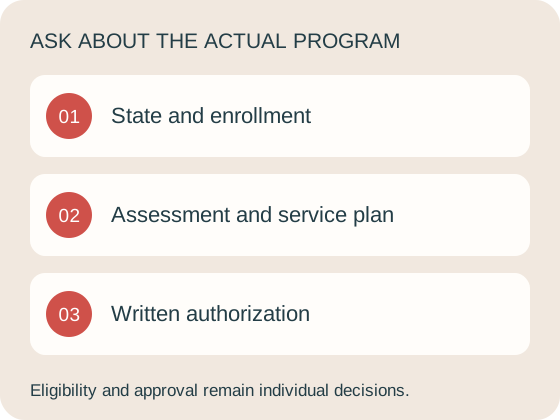
Coverage starts with the actual state benefit
The useful question is: “Which program could consider this adaptation for this person?” A general answer that Medicaid covers home modifications leaves out the enrollment and project decisions that come next.
CMS explains that 1915(c) home and community-based services waivers can target particular populations, require an institutional level of care and limit enrollment. Services follow an individualized plan. [1] A different authority, 1915(i), allows state-plan HCBS with state-defined needs criteria and services that may include environmental modifications. [2] These federal frameworks do not themselves approve a stairlift.
Ask whether the proposed equipment and installation belong under an environmental adaptation, another waiver service or the state-plan equipment benefit. A supplier’s use of the phrase “medical equipment” does not settle the program’s classification. The relevant decision is how the responsible payer treats the actual request.
This is a government-source editorial preview, checked October 25, 2026. Independent Medicaid benefits-specialist review is pending. It organizes public information and planning questions; it does not determine personal eligibility or replace a written program decision.
Find the office responsible for your request
Start with your current enrollment documents and the name of any case manager or service coordinator. If you are unsure about enrollment or where to apply, Medicaid.gov directs those questions to the state Medicaid agency and provides official state contacts. [3]
| Your starting point | What to establish |
|---|---|
| Already receiving waiver services | Exact waiver name, assigned coordinator and applicable home-adaptation service. |
| Medicaid enrolled, waiver status unknown | Whether the current benefit can consider the request or requires a separate assessment and enrollment. |
| Applying for Medicaid | Which agency screens the relevant coverage group and long-term support needs. |
| Enrolled through a managed care plan | Whether this request belongs with the plan or a separately administered program. |
Keep a short contact record: office, person, date, program name and next action. If transferred, explain the equipment and home-access problem again; do not assume the receiving office has the earlier conversation.
Leave the call knowing who will assess the request, what information it needs first and how you will receive an answer. “We sometimes cover adaptations” is useful context, but it is not a decision on your project.
Three state examples show why the details matter
These examples concern named programs. They do not describe every Medicaid benefit in each state. The dates below belong to the cited rule or manual page; all sources were checked for this guide on October 25, 2026.
| State and program | Source date and useful evidence | Question for the coordinator |
|---|---|---|
| Ohio: Individual Options and Level One waivers | Rule 5123-9-23, effective July 1, 2026, requires an individual service plan and an in-home assessment by a qualified professional. [4] | Which assessment and certified adaptation provider are needed for this project? |
| Washington: DDA HCBS waivers | WAC 388-845-0900, effective January 11, 2026, expressly includes stair lifts as an adaptation example. [5] WAC 388-845-0910, with the same effective date, requires prior approval and itemized bids. [6] | Which waiver limits, bid requirements and approval steps apply before work starts? |
| Minnesota: CADI waiver, environmental accessibility adaptations | The DHS manual page displays an October 23, 2024 update. Its functional-use examples include a stair lift in the exception criteria; it also describes assessment and installation services. This is a manual date, not a new 2026 rule. [7] | How does the lead agency evaluate the assessed need, available budget and any exception request? |
Ohio’s separate equipment FAQ places permanent lift systems attached to a home within environmental adaptations; the relevant page is dated November 8, 2024. [8] That classification helps frame an inquiry. It does not establish approval for a particular stairlift.
A state page naming a product is only one piece of evidence. Keep the program name and the person’s enrollment attached to that finding, so a rule for developmental-disability services is not accidentally applied to an unrelated older-adult program.
Prepare the assessment and project information
Have the coordinator identify the required documents before paying for reports or collecting bids. The following worksheet organizes the conversation; it is not a universal Medicaid application checklist.
- Access problem: which rooms or entrance cannot be reached, how often the route is needed and what has changed.
- Assessment: who must evaluate the person and home, whether a referral is needed and who arranges it.
- Project scope: equipment type, installation work, electrical work, permits and any other proposed alteration.
- Property: ownership or tenancy, the address and any consent the program requires.
- Provider: the qualifications and program enrollment required of the assessor and installer.
- Submission: who sends the request, what constitutes a complete file and how to track it.
Describe the daily task rather than insisting that one advertised product is the only answer. For example, explain the need to reach an upstairs bathroom and the existing boarding space. Let the assessment address suitable solutions. Our alternatives guide helps distinguish a seated stairlift from other access equipment.
Photos can clarify the staircase and landings if the reviewing office requests them. Ask for its approved submission method. Keep identification numbers, medical records and other sensitive documents out of an ordinary commercial quote form unless they are specifically required through an appropriate channel.
Separate a pending file, an enrollment limit and a denial
If progress stops, ask what stage the request has reached. A missing assessment, a program-enrollment issue and a refusal of the requested service need different follow-up. Record the outstanding item and which person or office must act.
For 1915(c), the federal description permits states to limit the number served. [1] That does not tell you whether a particular program currently has a waiting list or whether you are on it. Obtain the actual program status and ask what any waiting-list entry means for this request.
For an adverse decision, retain the notice and its stated reason. CMS describes a right to request a fair hearing for certain state-agency decisions or lack of reasonably prompt action. [9] Follow the instructions applicable to your decision; managed care and state-agency procedures can differ. Ask the issuing office or a qualified adviser to explain the route and deadline before choosing a response.
Correcting a missing document is useful, but do not assume a telephone conversation preserves a deadline. Keep confirmation of anything submitted and the next response date you were given. This guide supplies no universal appeal form or deadline.
Keep benefits, quotes and longer-term costs together
Use a simple project record with four statuses: requested, under review, approved and completed. Assign the status to each item of work. This avoids treating one encouraging call as approval for the entire installation.
For any approved project, ask about completion evidence, the handover, ownership of the equipment and who to contact for repairs. Confirm whether future maintenance or removal is addressed by that program or needs a separate decision. Do not infer ongoing coverage from the original installation approval.
If another organization may contribute, disclose the proposed assistance to the responsible program and ask how the costs should be coordinated. Do not promise the same invoice to two funding sources or treat an application as money already available.
Our assistance finder lists selected researched options with source checks. The funding guide explains how to organize inquiries. If you also receive Medicare or VA benefits, use the separate Medicare and VA guides to prepare questions for those programs. None of these resources confirms an award or submits a benefit application.
Common questions
Does Medicaid cover stairlifts in every state?
There is no single nationwide stairlift benefit established by the sources in this guide. Identify the state program, covered service and individual approval requirements. The three examples above are scoped to named programs, not all residents of those states.
Is a prescription enough to get a stairlift approved?
A recommendation can support a request, but it does not settle enrollment, the covered service, provider requirements or payment authorization. Ask the responsible coordinator what additional assessment and project evidence it requires.
Can I buy a stairlift and claim the money later?
Do not buy in expectation of reimbursement without the responsible program’s written instructions and applicable authorization. A pending request is not a payment commitment. Ask about urgent-access planning if you cannot wait for the normal process.
Can Medicaid help with a stairlift in a rented home?
Ask about the exact program’s property and consent rules. Washington’s cited DDA rule, for example, requires written landlord consent before adaptations begin. That example does not establish the rules or an approval in another program.
What if I have Medicaid but no waiver or case manager?
Contact the state agency using Medicaid.gov’s official state contacts. Explain the home-access need and ask which benefit or assessment route can consider it. Do not assume either that enrollment is automatic or that a waiver is the only possible pathway.
Does this guide check whether I qualify?
No. It provides public-source research and inquiry tools. Eligibility, enrollment availability, project suitability and authorization require the responsible program’s assessment. Independent benefits-specialist review of this editorial preview is still pending.
Evidence & accountability
Sources and research method
We reviewed the linked manufacturer, provider and public guidance. Published terms are attributed to that source and can change. These guides use original explanations and clearly marked hypothetical examples; we have not inspected the equipment or performed these installations.
Prepared with AI assistance. No independent installer or clinical review is claimed. No independent benefits, financial or tax review has been completed. A qualified installer must assess the home and proposed equipment. Read our research method and evidence standards.
- CMS: 1915(c) HCBS waiver framework ↗Checked October 25, 2026
Federal framework only; no individual waiver enrollment or current waiting list verified.
- CMS: 1915(i) state-plan HCBS ↗Checked October 25, 2026
State-defined framework; no specific 1915(i) stairlift coverage asserted.
- Medicaid.gov: official state contacts ↗Checked October 25, 2026
Public agency-contact route; no application or beneficiary account accessed.
- Ohio: Rule 5123-9-23 ↗Checked October 25, 2026
Current published rule effective July 1, 2026; named-waiver requirements only.
- Washington: WAC 388-845-0900 ↗Checked October 25, 2026
Current published text effective January 11, 2026; DDA HCBS scope.
- Washington: WAC 388-845-0910 ↗Checked October 25, 2026
Current published text effective January 11, 2026; approval, bids and rental consent. Monetary limits not reused.
- Minnesota DHS: environmental accessibility adaptations ↗Checked October 25, 2026
Retrieved manual displays update October 23, 2024. CADI example; no current dollar limit or individual exception approval asserted.
- Ohio DODD: equipment and adaptation classification FAQ ↗Checked October 25, 2026
Page 3 dated November 8, 2024. Classification example read alongside the newer rule; no billing-code instructions reused.
- CMS: Medicaid eligibility policy and hearings ↗Checked October 25, 2026
General hearing principle only; no individual deadline, benefit election or legal assessment provided.
Keep planning
Read local installation research
Minneapolis, MN · Columbus, OH · Seattle, WA · All cities
Prepare your stairlift enquiry ↗Melt Media Group reviews your request and follows up about installer options. We identify the proposed company and ask before sharing your details.